

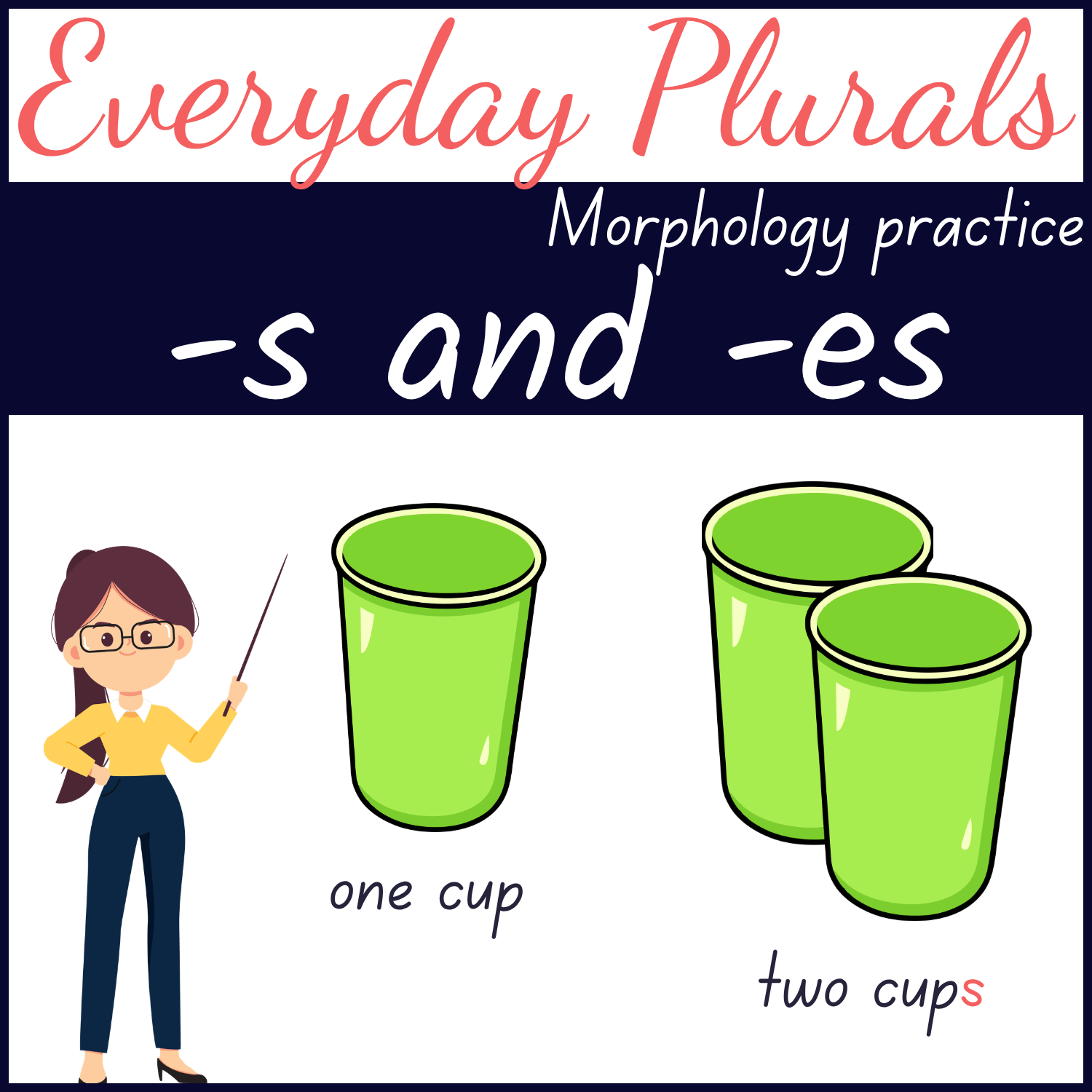
Looking for a simple way to teach plural -s and -es in speech therapy? Start with something students can see: one cup beside two cups. Then connect that change in meaning to the word ending. A few familiar pictures and a repeatable routine can keep your morphology activities easy to plan.
This guide walks through a practical one-to-many activity, with examples from Everyday Plurals.
Start with one and more than one
Before choosing an ending, make the meaning clear. Place one object on one side and two of the same object on the other. Point and model: “One cup. Two cups.” You can use classroom objects, toys, or picture pairs.
Invite the student to point to “one” and “more than one,” then switch the pictures around. If naming the object is difficult, supply the noun so the task stays focused on plurals rather than unfamiliar vocabulary.
When do you add -s or -es?
Many regular plural nouns take -s. For the words in this activity, nouns ending in s, x, sh, or ch take -es. Keep the first comparison small: try cup → cups beside box → boxes.
| Ending | One | More than one |
|---|---|---|
| Add -s | hat, cup, dog | hats, cups, dogs |
| Add -s | toy, bag, bed | toys, bags, beds |
| Add -es | bus, box, dish | buses, boxes, dishes |
| Add -es | watch, brush | watches, brushes |
These examples are a starting set, not a rule for every English noun. Words such as baby → babies involve another spelling change, while child → children is irregular. Introduce those patterns separately. Cambridge Dictionary’s guide to noun forms gives a broader overview.
Try this cut-and-paste plural activity
- Name it. Point to the single picture and say the base word: “dog.”
- Compare it. Follow the arrow to the pictures showing more than one: “Now there are two.”
- Choose the ending. Offer the -s and -es tiles. Use the spelling visual as a reference when appropriate.
- Build the word. Cut and glue the chosen ending next to the noun. Read or say the completed word together: “dogs.”
- Use it. Finish a short sentence: “I see two dogs.”
For students who are not reading yet, model the spoken plural while using the tiles as visual supports. Choosing a written suffix and saying a plural word are different tasks; you can support each one separately.
Keep spoken plurals and spelling connected
The written ending does not always sound the same. Compare the /s/ in cups, the /z/ in dogs, and the extra syllable in buses. Model the whole word naturally rather than asking for an /s/ sound on every plural. Oxford Learner’s Dictionaries explains the pronunciations of the plural ending.
Make practice easier—or take it into conversation
Need more support? Start with two familiar nouns, give a spoken model, and keep the picture guide nearby. Once the routine is familiar, mix -s and -es words, reduce the prompts, or ask students to describe what they see without a sentence starter.
Finish with a quick classroom search: find one book, two pencils, or several bags. Notice whether the student uses the plural independently, after a reminder, or after your model. A worksheet response and an everyday conversation give you different information.
A ready-to-use resource for regular plural practice
Everyday Plurals includes 11 picture-supported cut-and-paste activities in a 19-page printable PDF. You’ll also get an illustrated ending guide, a spelling visual, teacher directions, an answer key, and a practice tracker. Print only the pages you need for your session.