

Not sure how to teach syntax or help students expand their sentences? Use this guide and the matching syntax lessons for speech therapy to choose a sentence pattern, see clear examples, and plan what to work on next.
Use it as a quick shop guide when planning your next session. You can start with the free SV lesson, choose one specific pattern, or get the full five-lesson bundle.
Your syntax lesson sequence at a glance
The bundle follows this order: SV → SVO → SVOO → SVC → SVOC. This is the order of these resources, rather than a requirement for every student. Choose the sentence pattern that fits the goals you are already working on.
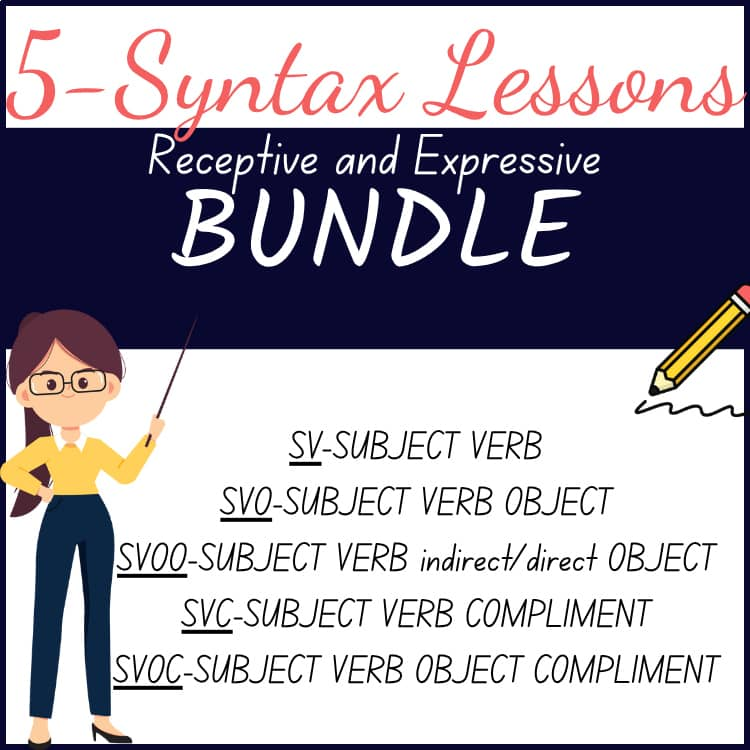
| Lesson | Sentence pattern | Example |
|---|---|---|
| 1. SV (free) | Subject + verb | The girl runs. |
| 2. SVO | Subject + verb + object | The girl reads a book. |
| 3. SVOO | Subject + verb + indirect object + direct object | The boy gives his friend a pencil. |
| 4. SVC | Subject + linking verb + subject complement | Maya is happy. |
| 5. SVOC | Subject + verb + object + object complement | The class named the hamster Peanut. |
Lesson 1: SV — who is doing something?
SV sentences bring together a subject and a verb. In “The girl runs,” the girl is the subject and runs is the verb. Choose this lesson when you want materials focused on that two-part sentence pattern.
Get the free printable SV syntax lesson. It is an easy way to explore the lesson format before choosing the rest of the collection.
Lesson 2: SVO — add an object
SVO adds an object to the subject and verb. Compare “The girl runs” with “The girl reads a book.” In the second sentence, a book tells us what the girl reads.
Explore the SVO syntax lesson for subject–verb–object practice.
Lesson 3: SVOO — giving sentences
SVOO includes two objects. In “The boy gives his friend a pencil,” his friend is the indirect object—the recipient—and a pencil is the direct object—the thing given.
Choose the SVOO syntax lesson for this pattern. For more activity ideas, read How to Teach Giving Sentences.
Lesson 4: SVC — describe the subject
SVC uses a complement that tells us about the subject. In “Maya is happy,” happy describes Maya. The linking verb is connects the subject with that description.
This differs from an SVO sentence: happy is a description of Maya, rather than an object receiving an action. View the SVC syntax lesson.
Lesson 5: SVOC — describe or name the object
SVOC includes an object and a complement that describes or names that object. In “The class named the hamster Peanut,” the hamster is the object and Peanut names it.
View the SVOC syntax lesson for object-complement practice.
Individual lesson or the full bundle?
If you need one sentence pattern, pick the matching individual lesson. If you want all five core patterns together, choose the Core Sentence Structures Syntax Bundle. The free SV lesson is also available separately.
Looking for a build–read–write activity with movable word cards? That is a different resource type. Read the sentence-building mats guide to compare it with the lessons.
Keep this page handy when planning, or browse all syntax lessons to find your next resource.