
Helping students move from single words to full sentences can feel overwhelming—but it doesn’t have to be.
If your students can label objects but struggle to form sentences, you’re not alone. Sentence building is one of the most common challenges in speech therapy, especially for early language learners.
The good news? With the right activities, you can make sentence building simple, structured, and even fun.
In this post, you’ll find easy sentence building activities you can use right away in your speech therapy sessions.
What is Sentence Building in Speech Therapy?
Sentence building is the process of helping students combine words into meaningful phrases and sentences.
This typically follows a progression:
-
- Single words
-
- Simple sentences (Subject + Verb + Object)
-
- Expanded sentences (adding more details)
If you want a deeper breakdown of how sentence structure works, check out this guide on syntax and sentence structure.
1. Sentence Building Mats (Best Place to Start)
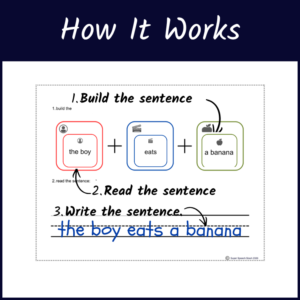
Sentence building mats are one of the easiest and most effective ways to teach sentence structure.
They give students a visual framework for building sentences step-by-step:
-
- Subject
-
- Verb
-
- Object
This reduces overwhelm and helps students understand how sentences are formed.
They’re especially helpful for:
-
- Early language learners
-
- Students who need visual support
-
- Structured practice during sessions
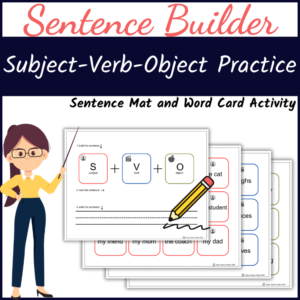
Ready to try this in your sessions? Check out these SVO sentence building mats that make teaching simple sentences easy and engaging.
2. Cut and Paste Sentence Activities
Hands-on activities are great for keeping students engaged.
With cut-and-paste sentence building:
-
- Students physically arrange words
-
- They see how sentences are formed
-
- It reinforces word order
This works especially well for:
-
- Preschool and kindergarten
-
- Students who benefit from tactile learning
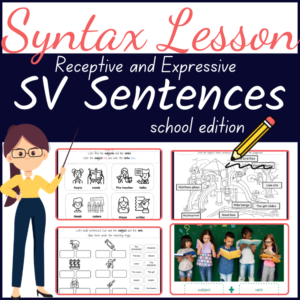
If you’re focusing on simple sentence structure, you can start with SVO sentences.
Learn more about teaching simple sentences step-by-step here.
3. Sentence Expansion Activities
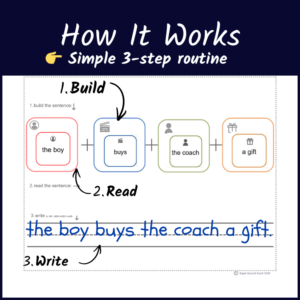
Once students can form simple sentences, the next step is expanding them.
Start with a basic sentence:
-
- “The dog runs.”
Then expand:
-
- “The big dog runs fast.”
This helps students:
-
- Add detail
-
- Improve grammar
-
- Build longer utterances
Sentence expansion is a natural progression from simple sentence building.
You can explore more advanced sentence structures like giving sentences (SVOO) here.
4. Picture Description Activities
Using pictures is a simple way to encourage sentence building.
Show a picture and prompt students with:
-
- “Who?”
-
- “What are they doing?”
-
- “What are they using?”
This helps guide them into forming complete sentences without overwhelming them.
5. No-Prep Sentence Building Activities
Not every session needs materials.
Try quick verbal prompts like:
-
- “Tell me a sentence about a dog.”
-
- “What is the boy doing?”
-
- “Who is eating the apple?”
These are perfect for:
-
- Busy sessions
-
- On-the-go therapy
-
- Reinforcing skills without prep
How to Choose the Right Sentence Building Activity
The best activity depends on your student’s level:
-
- Beginner: Focus on simple SVO sentences
-
- Intermediate: Work on sentence expansion
-
- Advanced: Introduce more complex structures like SVOO
Start simple, then build complexity over time.
Make Sentence Building Easier
Teaching sentence structure doesn’t have to be complicated.
When you use structured, visual, and engaging activities, students can build confidence and start forming sentences more easily.